
Everest Region (Khumbu), Nepal
Mera Peak with Everest Base Camp
Twenty-one days up the remote Hinku valley to the summit of Mera Peak at 6,476 m, then over the technical Amphu Laptsa pass into the Khumbu and on to Everest Base Camp — an expedition rather than a trek.
Package Overview
Best Time to Visit
April to May, October to November
Guided & Permitted
Licensed, insured guide and all trekking permits included
The honest description of this trip
This is a mountaineering expedition. It is sold across the internet as a trek with a climb attached, and that description is misleading enough to be worth correcting in the first paragraph.
The summit of Mera Peak at 6,476 m is, by 6,000 m standards, technically straightforward — a long snow slope with a short steep step near the top. The hard part of this itinerary is not the peak. It is Amphu Laptsa at 5,845 m, the pass that links the Hinku valley to the Khumbu, and it is a technical crossing involving steep snow and ice, fixed ropes and abseiling with a serious drop beneath you.
If you want Mera Peak, we can take you up it and back down the way you came in around sixteen days. If you want Mera Peak and Everest Base Camp in one continuous journey, Amphu Laptsa is the only way to link them, and this page is about that trip.
Why Mera, and what you see from the top
Mera is the highest peak in Nepal that can be climbed on a trekking permit rather than an expedition permit. That makes it the highest summit most people will ever reach, and the view is the reason it is worth reaching.
From the top, on a clear morning, five of the world's fourteen eight-thousanders are visible: Everest, Lhotse, Cho Oyu, Makalu and Kanchenjunga. There is nowhere else in Nepal at a non-technical altitude that offers that.
The approach is the other attraction. The Hinku valley is separated from Khumbu by the Zatrwa La and sees a tiny fraction of the traffic — no bakeries, no wifi worth the name, and days when you will see nobody. After two weeks of that, walking into Namche on the way out is genuinely disorienting.
Amphu Laptsa: read this before you book
We are going to be specific, because this is the crux and most pages gloss it.
| What it involves | What that means for you |
|---|---|
| Steep snow and ice on both sides | Crampons, ice axe and rope from before dawn |
| Fixed rope and abseil on the Khumbu descent | You must be able to abseil confidently, in the dark, tired |
| No escape route once committed | There is no path down from the pass except over it |
| Eight to nine hours on the crossing day | At altitudes above 5,500 m throughout |
| Weather-dependent | Heavy snow can close it outright |
If the pass is closed when we get there, the alternative is to retreat down the Hinku and fly out from Lukla, which means no Everest Base Camp. We build a contingency day in, we watch the forecast, and we will not cross it in bad conditions. You should book this trip understanding that outcome is possible.
Anyone who is not confident on an abseil should either train before coming or book Island Peak with Everest Base Camp, which reaches a 6,189 m summit with no pass crossing and no committed ground.
What you need to bring to this, personally
This is the one trip we run where we will decline a booking on experience grounds.
- Previous experience above 5,000 m is expected. This is not a first Himalayan trip.
- Prior use of crampons, ice axe and rope, whether on a course or a previous climb. We teach and refresh, but we are not teaching from zero on this itinerary.
- Genuine hill fitness: twenty-one days, two nights above 5,700 m, and a 6,476 m summit day.
- Comfort with commitment: from Khare to the Khumbu there is no road, no helicopter landing site you can walk to easily, and no way around the pass.
Tell us honestly what you have done. We would much rather move you to a different trip at the enquiry stage than have the conversation at 5,800 m.
The altitude plan
Twenty-one days is long, and almost all of the extra length over a standard Everest Base Camp trek is acclimatisation rather than distance.
The route crosses the Zatrwa La (4,610 m) early, which is a useful high point in the first week. It then climbs the Hinku gradually to Khare (5,045 m), where a rest and skills day sits before the peak. Summit day runs from a high camp at around 5,780 m.
After the summit the route does not descend far, because Amphu Laptsa is still to come — which means several consecutive nights above 5,000 m. This is the most sustained time at altitude of any trip we sell, and it is why the experience requirement above is not negotiable.
Crew, and why the group is small
We cap this trip at six clients. Amphu Laptsa requires fixing rope and managing an abseil for every member of the party, and beyond six that becomes slow enough to be a safety problem in its own right — a party strung out on a pass in deteriorating weather is the situation to avoid.
You travel with a certified climbing guide, climbing sherpas in proportion to group size, a cook and kitchen crew for the tented sections, and porters. On summit day and on the pass the ratio is close to one to one.
Permits — five of them
- NMA climbing permit for Mera Peak, seasonal fee
- Makalu Barun National Park entry permit, for the Hinku valley
- Sagarmatha National Park entry permit, for the Khumbu side
- Khumbu Pasang Lhamu rural municipality fee
- TIMS card
The trip crosses between two national parks, which is why there are two park permits rather than one. All are included.
Season
April to May and October to November only, and this trip is more weather-sensitive than the others because of the pass. Spring usually gives better snow conditions on Amphu Laptsa; autumn gives clearer summit views from Mera.
We will not run it outside those windows. A technical pass at 5,845 m in winter or monsoon conditions is not a trekking proposition and no price makes it a reasonable one.
Where this trek goes
- Kathmandu Valley — Seven UNESCO Monument Zones within an hour of each other
Related activities: Peak Climbing in Nepal, Mountaineering Expeditions.
Or compare every trip we run: all trekking and tour packages.
Trip Highlights
Mera Peak (6,476 m), the highest of Nepal's designated trekking peaks
Five 8,000 m summits visible from the top: Everest, Lhotse, Cho Oyu, Makalu, Kanchenjunga
Amphu Laptsa (5,845 m) — a genuinely technical pass crossing
The Hinku valley, remote and almost empty compared to Khumbu
Everest Base Camp and Kala Patthar on the way out
Two 6,000 m nights and a full expedition crew
Live Weather
Detailed Itinerary
1
Day 1: Kathmandu (1,400 m) — arrival, briefing and kit check
Airport transfer and a thorough equipment check with your climbing guide. On this trip the check is genuinely searching — boots, crampon fit, harness, jacket, gloves and sleeping bag are all inspected, and we would rather find a problem in Thamel than at Khare. Full briefing on the summit plan and on Amphu Laptsa.
2
Day 2: Fly to Lukla (2,840 m), trek to Chutanga (3,050 m)
The early Lukla flight, then a turn immediately away from the Everest trail and south-east into forest — most people on your flight are walking north and you will not see them again for a fortnight. Three to four hours to Chutanga, a clearing below the Zatrwa La. The quiet starts on day one.
3
Day 3: Chutanga to Thuli Kharka (4,300 m) over Zatrwa La (4,610 m)
Six to seven hours and a serious first pass. A steep climb to the Zatrwa La with Khumbu behind you and the Hinku valley ahead, then a descent to Thuli Kharka. It is a big altitude gain for day three and the day the trip announces its character. Basic lodge or camp.
4
Day 4: Thuli Kharka to Kothe (3,600 m)
Five to six hours descending into the Hinku valley proper, dropping through rhododendron and pine to the river. Mera Peak comes into view ahead for the first time. Losing 700 m feels generous and is good for acclimatisation — you will climb it all back and more.
5
Day 5: Kothe to Thangnak (4,350 m)
Four to five hours following the Hinku Khola upstream with the valley opening and the Charpate Himal above. We stop at the small gompa at Gondishung, built into a rock overhang and several hundred years old. Thangnak is a summer grazing settlement with a few basic lodges.
6
Day 6: Thangnak to Khare (5,045 m)
Four to five hours climbing beside the Dig glacier moraine into high, bare country. Khare is the base for the peak — a cluster of simple lodges at just over 5,000 m with Mera's north face directly above and the route clearly visible from the doorway.
7
Day 7: Khare — acclimatisation and climbing skills day
A rest day in name only. We walk several hundred metres up towards Mera La and return, and run a full skills session on the glacier ice: crampon technique, ice axe, roped travel, jumar work and abseiling. The abseil practice matters as much for Amphu Laptsa in two weeks as it does for the peak in two days.
8
Day 8: Khare to Mera High Camp (about 5,780 m)
Five to six hours, crossing Mera La and climbing onto the glacier to the high camp on a rock shelf. Roped from the glacier onwards. A cold, exposed, spectacular camp with Makalu filling the eastern horizon. Early dinner and an attempt at sleep, which rarely goes well at 5,780 m.
9
Day 9: Summit Mera Peak (6,476 m), descend to Khare
Away between 2 and 3 am, roped, on a long steady snow slope that goes on for hours. A short steep step just below the summit is the only technical ground. From the top, on a clear morning, Everest, Lhotse, Cho Oyu, Makalu and Kanchenjunga are all visible — five eight-thousanders from one summit. Eight to ten hours in total, descending all the way to Khare.
10
Day 10: Contingency day for the Mera summit
Held in reserve for weather or a second attempt. Mera's summit slope is exposed to wind and a bad morning is simply a bad morning. If day nine went to plan, we use this to rest at Khare before the pass, which is not wasted time — the second half of this trip is harder than the first.
11
Day 11: Khare to Kongma Dingma (4,850 m)
Five to six hours descending and then contouring north into the upper Hinku towards the Amphu Laptsa approach. Lower, warmer and a genuine recovery day after the summit. The valley here is empty in a way that is difficult to convey.
12
Day 12: Kongma Dingma to Seto Pokhari (5,035 m)
Five to six hours climbing past a chain of glacial lakes into the head of the valley, with Baruntse and Chamlang rising ahead. Camp beside the lakes at just over 5,000 m. From here there is no way out except over the pass, and the crew begins preparing rope and hardware for tomorrow.
13
Day 13: Seto Pokhari to Amphu Laptsa Base (5,400 m)
Three to four hours over moraine and glacier to a camp directly beneath the pass. A short day deliberately — the crossing tomorrow is long and committed, and arriving early to rest, eat and sort equipment is worth more than distance. The guide briefs the rope order and the turnaround decision before dark.
14
Day 14: Cross Amphu Laptsa (5,845 m) to Chhukung (4,730 m)
The crux of the expedition. A pre-dawn start on steep snow and ice, roped throughout, to the pass itself. The Khumbu side is the serious part: fixed ropes and abseils down a steep face with a substantial drop, taken one at a time. Then a long descent to Chhukung and, suddenly, lodges and other people. Eight to nine hours and the hardest day of the trip.
15
Day 15: Chhukung to Dingboche (4,410 m)
Three to four hours of easy downhill walking into the main Khumbu, and a strange day psychologically — the climbing is over, the commitment is behind you, and there are bakeries. Dingboche has hot showers and a menu with more than four items on it.
16
Day 16: Dingboche to Lobuche (4,940 m)
Five to six hours up the Khumbu valley past the memorial stones at Thukla Pass. Having just come over Amphu Laptsa, the cairns commemorating climbers lost on these mountains read rather differently than they would have done a fortnight ago.
17
Day 17: Lobuche to Everest Base Camp (5,364 m), night at Gorak Shep (5,170 m)
Seven to eight hours along the Khumbu glacier to Base Camp, with the icefall above and, in spring, the expedition city spread across the ice. Everest itself is hidden behind Nuptse from here. Back to Gorak Shep for the night — your fourth or fifth night above 5,000 m on this trip, and by now it will feel almost normal.
18
Day 18: Kala Patthar (5,545 m), descend to Pheriche (4,240 m)
Pre-dawn to Kala Patthar for sunrise on the Everest south-west face — the view the whole Khumbu trail exists for. Then a long descent, six to seven hours, down to Pheriche and thicker air. After three weeks high, the oxygen at 4,240 m is a physical pleasure.
19
Day 19: Pheriche to Namche Bazaar (3,440 m)
Six to seven hours down through Tengboche and across the Dudh Koshi to Namche. A long day with a sting in the climb up from Phunki Thenga. Namche after twenty-one days in the mountains, five of them above 5,000 m, is the best town in the world for one evening.
20
Day 20: Namche Bazaar to Lukla
Six to seven hours retracing the valley to Lukla. The final walking day. Settle accounts with the crew in the evening — the summit bonus and tips are given here, and your guide will advise on what is customary for a trip of this length and difficulty.
21
Day 21: Fly to Kathmandu, spare day
The morning flight out of Lukla, weather permitting, with the day kept clear because Lukla cancellations are routine. If it runs, the afternoon is yours in Kathmandu. Do not book your international departure for tonight — on a twenty-one day expedition the margin is worth protecting to the end.
Cost Details
What's Included
- Return flights, Kathmandu to Lukla
- NMA climbing permit for Mera Peak
- Makalu Barun and Sagarmatha National Park permits, municipality fee and TIMS card
- All accommodation: basic lodges in the Hinku, tented camps, lodges in Khumbu
- Full expedition crew: climbing guide, climbing sherpas, cook, kitchen crew and porters
- Breakfast, lunch and dinner throughout
- Climbing skills and abseil training day at Khare
- All group climbing equipment: ropes, ice screws, snow bars, fixed lines for the pass
- Personal climbing hardware on request: harness, helmet, jumar, ice axe, crampons
- Close to one-to-one guiding on summit day and on Amphu Laptsa
- Crew wages, insurance, equipment, food and accommodation
- First aid kit, pulse oximeter and emergency oxygen
- One contingency day for the summit and one spare day in Kathmandu
- Government taxes and company service charge
What's Not Included
- International flights and Nepal visa
- Travel insurance — must cover peak climbing to 6,500 m and helicopter evacuation
- Accommodation and meals in Kathmandu beyond arrival night
- Mountaineering boots, down jacket and sleeping bag rated to -30°C
- Hot showers, charging and bottled drinks where available
- Summit bonus for the climbing guide and sherpas, which is customary
- Tips for the crew
- Any cost arising from a closed pass, aborted summit, early descent or evacuation
Essential Information
- Maximum altitude: 6,476 m
- Trip duration: 21 days
- Difficulty: expert
- Best season: April to May, October to November
- Group size: 2 to 6 trekkers
- Permits: NMA climbing permit for Mera Peak; Makalu Barun National Park entry permit for the Hinku valley; Sagarmatha National Park entry permit; Khumbu Pasang Lhamu rural municipality fee; TIMS card — all included and arranged by us
- Accommodation: Basic lodges in the Hinku valley, tented high camps, lodges in Khumbu
- Guide: licensed and insured, English speaking
- Weather reference point: Khare
Important Cost Information
Payment Terms:
- • 25% deposit required to confirm booking
- • Balance payment due 30 days before departure
- • Full refund if cancelled 45+ days before
Fixed Departure Dates
Choose from our scheduled group departures with guaranteed departures.
Route Map
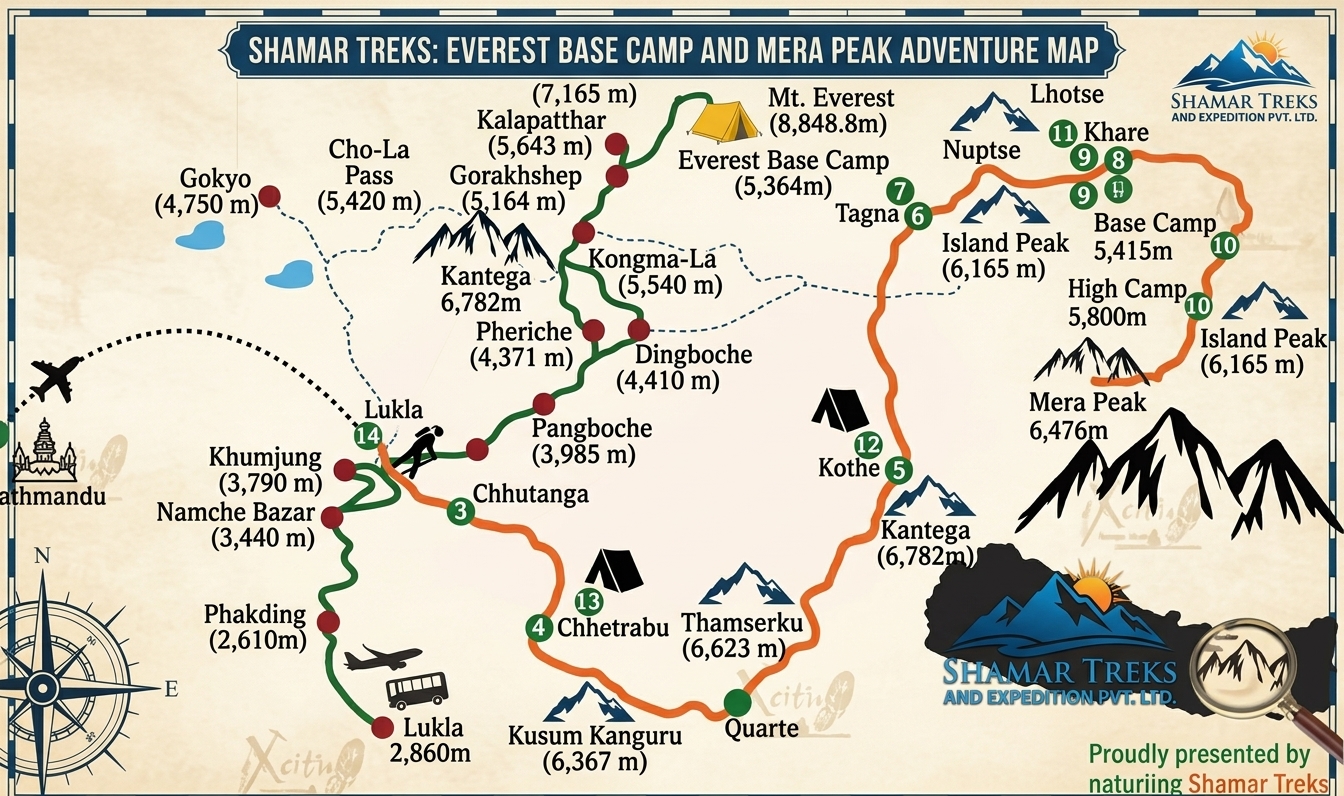
Route map image could not be loaded
Showing route for Mera Peak with Everest Base Camp
Route Information
Starting Point:Lukla
Ending Point:Lukla
Highest Point:Mera Peak (6,476 m)
Key Locations
Lukla
Day 2
start
2,840 m
Zatrwa La
Day 3
landmark
4,610 m
Kothe
Day 4
3,600 m
Khare
Day 6
5,045 m
Mera High Camp
Day 8
5,780 m
Mera Peak summit
Day 9
viewpoint
6,476 m
Seto Pokhari
Day 12
5,035 m
Amphu Laptsa
Day 14
landmark
5,845 m
Everest Base Camp
Day 17
landmark
5,364 m
Kala Patthar
Day 18
viewpoint
5,545 m
Frequently Asked Questions
Mera Peak is 6,476 m, the highest of Nepal's designated trekking peaks. High camp is at around 5,780 m. The other high point of this itinerary is Amphu Laptsa pass at 5,845 m, and on the Khumbu side you also reach Kala Patthar at 5,545 m.
Still have questions?
Our travel experts are here to help you plan the perfect trip. Get in touch with us for personalized advice.
Reviews & Ratings
—
0 reviews
5★
0
4★
0
3★
0
2★
0
1★
0
Share Your Experience
Have you completed this trek? Help other travelers by sharing your experience.