
Everest Region (Khumbu), Nepal
Island Peak with Everest Base Camp
Nineteen days combining the walk to Everest Base Camp with the ascent of Island Peak at 6,189 m — the most accessible first 6,000 m summit in Nepal, and considerably more technical than the phrase "trekking peak" suggests.
Package Overview
Best Time to Visit
April to May, October to November
Guided & Permitted
Licensed, insured guide and all trekking permits included
"Trekking peak" is a permit category, not a difficulty rating
Island Peak is classified by the Nepal Mountaineering Association as a trekking peak. That phrase has probably caused more disappointment on this mountain than any other single thing, because it describes how the permit is administered and nothing whatever about what the climb involves.
Here is what it actually involves: a roped glacier crossing with crevasses, a steep headwall of snow and ice climbed on fixed rope with a jumar, and an exposed summit ridge. You will wear a harness, a helmet and crampons, you will be roped to a guide, and you will use an ice axe.
It is the most accessible 6,000 m summit in Nepal and a superb first one. It is not a walk.
What you actually need to be able to do
No previous mountaineering experience is required, which is true and regularly misunderstood. What is required is this.
| Requirement | Why |
|---|---|
| Comfortable walking 6–8 hrs on consecutive days | The approach is a full Everest Base Camp trek |
| Steady in exposed places | The summit ridge has serious drops on both sides |
| Willing to be taught rope skills in a day | We run a dedicated skills session at base camp |
| Able to start walking at 1 or 2 am | Summit day is 10–14 hours from high camp |
| Prepared to turn around | The guide's decision is final and not refundable against |
The skills day at base camp is where you learn to use a jumar, walk in crampons, and move roped on a glacier. It is not a formality and we will not take a client onto the headwall who has not done it.
Why the Base Camp trek comes first
You could reach Island Peak in far fewer days by going straight up the Imja valley. Almost nobody who does that summits.
The itinerary walks to Everest Base Camp (5,364 m) and climbs Kala Patthar (5,545 m) before turning into the Imja valley, which means that by the time you reach Island Peak Base Camp at 5,087 m you have already been above 5,500 m and slept at over 5,000 m repeatedly. That is not sightseeing bolted onto a climb — it is the acclimatisation programme, and it is the single biggest factor in whether you stand on top.
It also means that if the summit does not happen, you have still done one of the great treks in the world rather than nothing.
Summit day, hour by hour
From high camp at around 5,600 m, and it is long.
- 1–2 am: away by headtorch on rock and scree, gaining height steadily in the dark.
- Around dawn: the glacier. Crampons on, rope on, and a crossing that may involve stepping over crevasses or a ladder, depending on the year.
- Mid-morning: the headwall — roughly 100 to 150 m of steep snow and ice on fixed rope, climbed with a jumar. This is the part people find hardest and it is entirely about pacing.
- The ridge: narrow, corniced, exposed, and short. Then the summit at 6,189 m, with Lhotse filling the sky directly north.
- Afternoon: all the way back down to base camp. The descent is where accidents happen, which is why we do not linger on top.
On summit success rates
We will not publish one. Any operator quoting you a percentage for Island Peak is quoting a number nobody can verify, drawn from a sample they chose, and the honest position is that it depends on three things: the weather window, how you acclimatised, and whether the fixed rope on the headwall is in good condition on the day.
What we will commit to is this. One guide per climber on summit day. A full acclimatisation programme rather than a compressed one. And a guide who will turn you around when they should, with the company's backing, because a client who is talked into continuing is the failure mode that actually kills people on this mountain.
Island Peak, Lobuche or Mera — choosing between them
| Island Peak | Lobuche East | Mera Peak | |
|---|---|---|---|
| Height | 6,189 m | 6,119 m | 6,476 m |
| Days with EBC | 19 | 18 | 21 |
| Summit day difficulty | Headwall and exposed ridge | Steeper, more sustained | Technically the easiest |
| Hardest element | The headwall | The climb itself | Amphu Laptsa, not the peak |
| Best for | A first 6,000 m peak | A short trip with real climbing | Height, and remoteness |
If you want the highest summit, Mera Peak is higher and its summit slope is easier — but reaching Everest Base Camp from it requires a technical pass. If you have less time, Lobuche East climbs directly off the Base Camp trail.
Permits, and why there are four
- NMA climbing permit for Island Peak — the fee is seasonal, higher in spring and autumn
- Sagarmatha National Park entry permit
- Khumbu Pasang Lhamu rural municipality fee, collected locally at Lukla
- TIMS card
All four are included. Solo climbing is not permitted on Island Peak: the NMA permit requires a certified climbing guide, which is why there is no version of this trip without one.
Equipment — what we provide and what you bring
We provide the group climbing hardware: ropes, ice screws, snow bars and the fixed line, plus a harness, helmet, jumar, carabiners and ice axe if you need them. Say so at booking and they will be waiting for you.
You bring, or rent in Kathmandu: mountaineering boots stiff enough to take a crampon, a down jacket rated for 6,000 m, a sleeping bag to -20°C, and proper gloves. Boots are the one item not to rent if you can avoid it — cold feet on the headwall end more summit attempts than anything except weather.
Season
April to May and October to November, and within those the middle weeks. Spring generally has more settled snow on the headwall; autumn has clearer air and colder nights. Outside these windows the mountain is not a reasonable objective and we do not run it.
Where this trek goes
- Kathmandu Valley — Seven UNESCO Monument Zones within an hour of each other
Related activities: Peak Climbing in Nepal, Trekking in Nepal.
Or compare every trip we run: all trekking and tour packages.
Trip Highlights
Island Peak (Imja Tse) at 6,189 m — a genuine glaciated summit
Everest Base Camp (5,364 m) and Kala Patthar (5,545 m) beforehand
A dedicated skills day at base camp before the climb
Ama Dablam, Lhotse and Nuptse at close range from the Imja valley
Acclimatisation built by the Base Camp trek rather than rushed
One climber to one guide on summit day
Live Weather
Detailed Itinerary
1
Day 1: Kathmandu (1,400 m) — arrival and briefing
Airport transfer and a full equipment check in the afternoon, which on a climbing trip is not a formality — we go through your boots, gloves, jacket and sleeping bag item by item, and there is time to rent or buy anything missing in Thamel. Your climbing guide meets you and talks through the itinerary and the summit-day plan.
2
Day 2: Fly to Lukla (2,840 m), trek to Phakding (2,610 m)
An early flight into Lukla, which is weather-dependent and the reason the itinerary has slack built in. Then three to four hours of easy downhill walking along the Dudh Koshi to Phakding. A deliberately short first day to let the altitude and the noise of the last twenty-four hours settle.
3
Day 3: Phakding to Namche Bazaar (3,440 m)
Five to six hours, crossing the Dudh Koshi repeatedly on suspension bridges before the long steady climb to Namche. Sagarmatha National Park permits are checked at Monjo. The final ascent is the first real work of the trip and the first view of Everest comes shortly before the town.
4
Day 4: Namche Bazaar — acclimatisation day
Walk high, sleep low. We go up to the Everest View Hotel and Khumjung or Syangboche at around 3,880 m and come back down. The afternoon is free in Namche — the Sherpa Culture Museum is worth an hour, and this is the last place with cash machines, real coffee and a serious gear shop.
5
Day 5: Namche to Tengboche (3,860 m)
Five to six hours, dropping to the river at Phunki Thenga and then climbing steadily through rhododendron to Tengboche. The monastery here is the spiritual centre of the Khumbu and the view from the courtyard — Ama Dablam, Everest, Lhotse, Nuptse — is among the most photographed in Nepal. Attend the evening puja if it is running.
6
Day 6: Tengboche to Dingboche (4,410 m)
Five to six hours with the treeline falling away behind you and the landscape turning to stone, scrub and grazing. Ama Dablam dominates the whole morning. Dingboche is a village of stone-walled potato fields and a surprising number of bakeries, and the first night above 4,400 m.
7
Day 7: Dingboche — acclimatisation day
A climb to Nangkartshang Peak at around 5,080 m above the village and back down to sleep. It is a hard afternoon and it is the most valuable acclimatisation day of the trip so far — the first time above 5,000 m, with Makalu visible to the east from the top on a clear day.
8
Day 8: Dingboche to Lobuche (4,940 m)
Five to six hours up the Khumbu valley past Thukla and the memorial stones at Thukla Pass, where cairns commemorate climbers lost on Everest. It is a sobering and appropriate place to be walking through on the way to a climb. Lobuche is a cold cluster of lodges beneath Lobuche Peak.
9
Day 9: Lobuche to Everest Base Camp (5,364 m), night at Gorak Shep (5,170 m)
Seven to eight hours: up the Khumbu glacier moraine to Gorak Shep, then out along the glacier to Base Camp itself, where in spring the expedition tents spread across the ice below the Khumbu icefall. There is no view of Everest from Base Camp — it is hidden by Nuptse — which surprises people. Back to Gorak Shep to sleep, the highest and coldest night so far.
10
Day 10: Kala Patthar (5,545 m), descend to Dingboche
A pre-dawn climb of two hours to Kala Patthar for sunrise, and this is where you see Everest properly — the full south-west face, with Nuptse and Changtse alongside. It is the highest point reached before the climb and the keystone of the acclimatisation plan. Then a long descent, five to six hours, back to Dingboche and thicker air.
11
Day 11: Dingboche to Chhukung (4,730 m)
Three to four hours turning east into the Imja valley, away from the Base Camp trail and the crowds with it. A short day by design — this is where the trek becomes a climb and there is no sense arriving tired. Chhukung is a handful of lodges with the Lhotse wall above.
12
Day 12: Chhukung to Island Peak Base Camp (5,087 m)
Four to five hours up the valley on moraine and grazing to the base camp, a tented site on sandy flats beneath the peak with the Imja glacier above. The crew pitches camp and you see the mountain properly for the first time — including the headwall, which tends to quieten a group considerably.
13
Day 13: Island Peak Base Camp — climbing skills day
The day the trip turns on. Your guide runs a full skills session on a nearby slope: walking in crampons, using an ice axe, ascending fixed rope with a jumar, abseiling, and moving roped as a team. If you have never done any of this, today is when you learn it. We do not take clients onto the headwall who have not completed this session.
14
Day 14: Base Camp to High Camp (about 5,600 m)
Three to four hours up rock and scree to the high camp, carrying only what is needed for the summit. An afternoon and evening of eating, drinking and trying to sleep at 5,600 m, which most people manage badly. The guide runs through the summit plan, the turnaround time and the rope order before dark.
15
Day 15: Summit Island Peak (6,189 m), descend to Chhukung
Away at 1 or 2 am. Rock and scree in the dark, then the glacier at first light — crampons and rope on, crevasses and possibly a ladder. Then the headwall: 100 to 150 m of steep snow and ice on fixed rope with a jumar, the hardest part of the climb. A short, narrow, corniced ridge to the summit, with Lhotse directly north. Ten to fourteen hours in total, all the way down to Chhukung. The longest day of your life, in all likelihood.
16
Day 16: Contingency day for the summit
Held in reserve and used more often than not. If the weather closes on day fifteen, or the fixed rope on the headwall is in poor condition, or the group needs a day, this is the second attempt. If the summit went to plan on day fifteen, we use it to walk down to Tengboche at a civilised pace instead.
17
Day 17: Chhukung to Namche Bazaar
Six to seven hours down the Imja valley and back onto the main Khumbu trail through Pangboche and Tengboche. A long descent, and a strange re-entry into a world of bakeries and wifi. Namche after a summit is one of the better evenings available in Nepal.
18
Day 18: Namche Bazaar to Lukla
Six to seven hours retracing the Dudh Koshi valley to Lukla, with the last hour an unwelcome climb. The final walking day. Settle up with the crew in the evening — this is when tips are given, and your guide will advise on what is appropriate.
19
Day 19: Fly to Kathmandu, spare day
A morning flight out of Lukla, weather permitting, and this is the reason the day is kept clear: Lukla cancellations are routine rather than exceptional, and a delay here would otherwise cost you your international flight. If the flight runs, the afternoon is free in Kathmandu. Do not book your flight home for tonight.
Cost Details
What's Included
- Return flights, Kathmandu to Lukla
- NMA climbing permit for Island Peak
- Sagarmatha National Park permit, municipality fee and TIMS card
- All lodge accommodation on trek, twin share
- Tented base camp and high camp with full crew and cook
- Breakfast, lunch and dinner throughout
- Certified climbing guide, one to one on summit day
- A dedicated climbing skills day at base camp
- All group climbing equipment: ropes, ice screws, snow bars, fixed line
- Personal climbing hardware on request: harness, helmet, jumar, ice axe, crampons
- Crew wages, insurance, equipment, food and accommodation
- First aid kit, pulse oximeter and emergency oxygen
- One contingency day for the summit and one spare day in Kathmandu
- Government taxes and company service charge
What's Not Included
- International flights and Nepal visa
- Travel insurance — must cover peak climbing to 6,500 m and helicopter evacuation
- Accommodation and meals in Kathmandu beyond arrival night
- Mountaineering boots, down jacket and sleeping bag — rentable in Kathmandu
- Hot showers, wifi, charging and bottled drinks in lodges
- Summit bonus for the climbing guide, which is customary
- Tips for guide, cook and porters
- Any cost arising from an aborted summit attempt, early descent or evacuation
Essential Information
- Maximum altitude: 6,189 m
- Trip duration: 19 days
- Difficulty: expert
- Best season: April to May, October to November
- Group size: 2 to 8 trekkers
- Permits: NMA climbing permit for Island Peak (Imja Tse); Sagarmatha National Park entry permit; Khumbu Pasang Lhamu rural municipality fee; TIMS card — all included and arranged by us
- Accommodation: Lodges on trek, tented base camp and high camp on the peak
- Guide: licensed and insured, English speaking
- Weather reference point: Chhukung
Important Cost Information
Payment Terms:
- • 25% deposit required to confirm booking
- • Balance payment due 30 days before departure
- • Full refund if cancelled 45+ days before
Fixed Departure Dates
Choose from our scheduled group departures with guaranteed departures.
Route Map
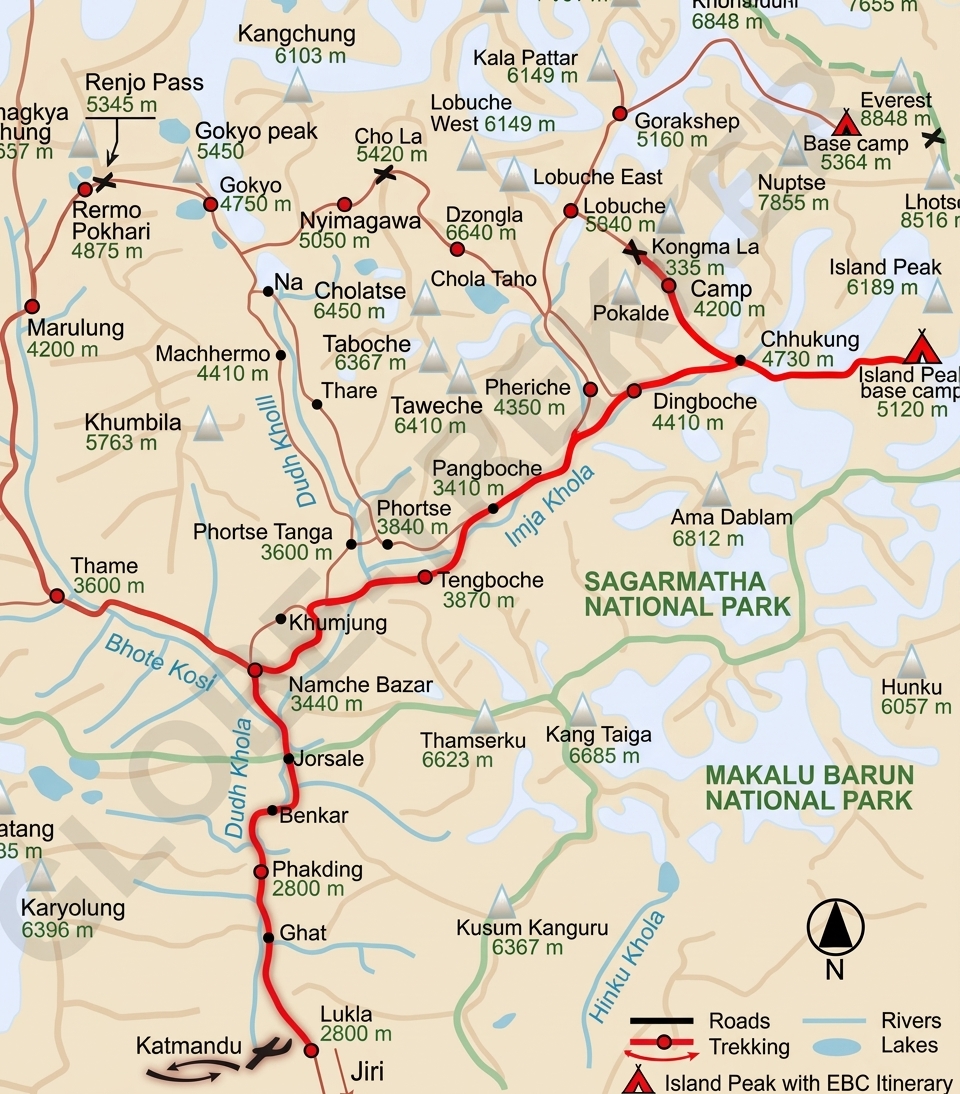
Route map image could not be loaded
Showing route for Island Peak with Everest Base Camp
Route Information
Starting Point:Lukla
Ending Point:Lukla
Highest Point:Island Peak (Imja Tse) (6,189 m)
Key Locations
Lukla
Day 2
start
2,840 m
Namche Bazaar
Day 3
3,440 m
Tengboche
Day 5
3,860 m
Dingboche
Day 6
4,410 m
Lobuche
Day 8
4,940 m
Everest Base Camp
Day 9
landmark
5,364 m
Kala Patthar
Day 10
viewpoint
5,545 m
Island Peak Base Camp
Day 12
5,087 m
Island Peak High Camp
Day 14
5,600 m
Island Peak summit
Day 15
viewpoint
6,189 m
Frequently Asked Questions
Island Peak, known locally as Imja Tse, is 6,189 m. Base camp is at 5,087 m and high camp at around 5,600 m. On the way in you also reach Everest Base Camp at 5,364 m and Kala Patthar at 5,545 m, which is how the acclimatisation is built.
Still have questions?
Our travel experts are here to help you plan the perfect trip. Get in touch with us for personalized advice.
Reviews & Ratings
—
0 reviews
5★
0
4★
0
3★
0
2★
0
1★
0
Share Your Experience
Have you completed this trek? Help other travelers by sharing your experience.